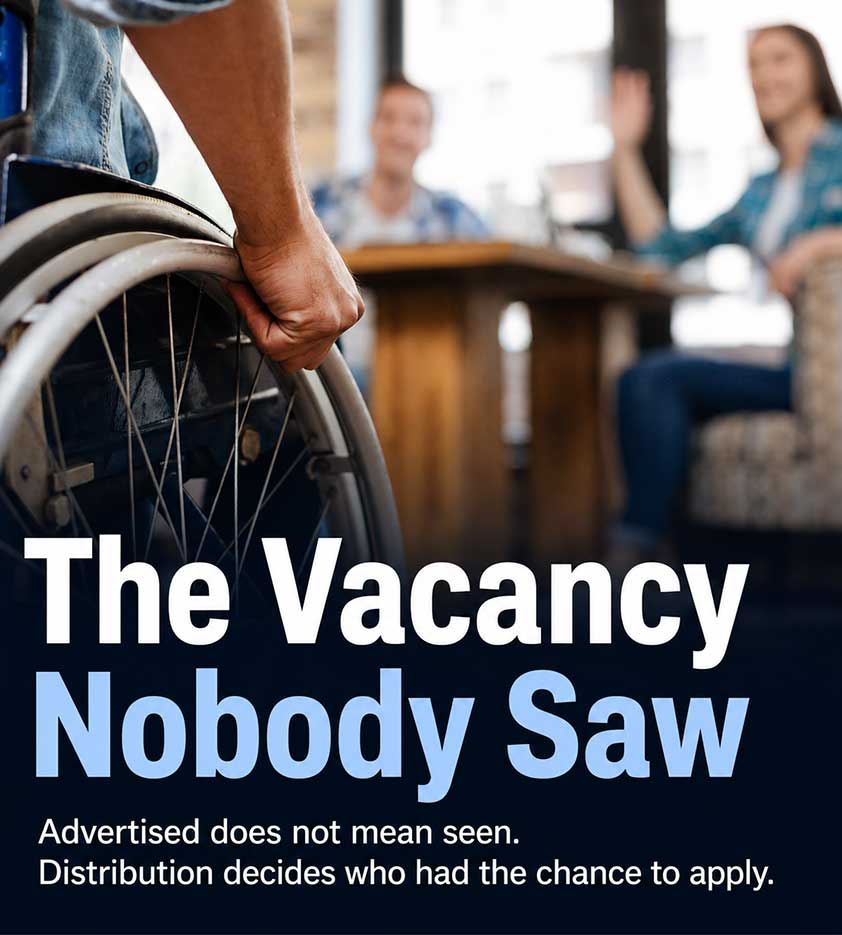
The Vacancy Nobody Saw


Every unfilled expectation in recruitment starts the same way: a role was advertised, so everyone assumes it was seen. Advertised and seen are not the same thing. For disabled candidates, who often rely on different networks, community organisations and trusted routes into work, the overlap between where you posted and where they look can be close to zero.
No system in your organisation currently detects this. The ATS starts counting at the application. The job board dashboard counts click without saying whose. The workforce report arrives a year later and records the consequence, fewer disabled applicants, fewer disabled hires, without identifying the cause. The failure sits in the one part of the process nobody monitors: distribution.
So, reach becomes an assumption. Ask a hiring manager where disabled candidates would have encountered their last vacancy, and you get a pause, then a guess involving the careers page. The honest answer is that nobody knows, because nobody decided and nothing was recorded. Multiply that by every vacancy in a year, and you have an organisation that cannot account for the most basic fact about its own recruitment: who had the chance to apply.
The alternative is unglamorous. Treat distribution as a governance step. One deliberate decision per vacancy regarding how to reach disabled candidates through the routes they use, written down with a date. Some employers make that decision by placing roles into established disabled communities through networks such as DisabilityNetwork.co.uk Some build their own community links. Minutes of effort, compounding into the only evidence that answers questions later.
Because eventually a candidate asks. Someone talented, wondering why they never heard about the role.